
For many years, packaging sustainability discussions focused primarily on recyclability. Today, that conversation is changing. As Extended Producer Responsibility (EPR) programs expand across North America and the European Union implements the Packaging and Packaging Waste Regulation (PPWR), policymakers are increasingly asking a different question: How can we reduce packaging before it becomes waste?
The most effective packaging waste is the waste that never needs to be managed.
Japan began exploring this approach decades ago, creating one of the world’s most successful packaging reduction stories through the widespread adoption of refill pouches. Today, refill pouches are a mainstream packaging format across Japan’s home and personal care market, offering a real-world example of what can happen when regulations, economics, and consumer needs align.
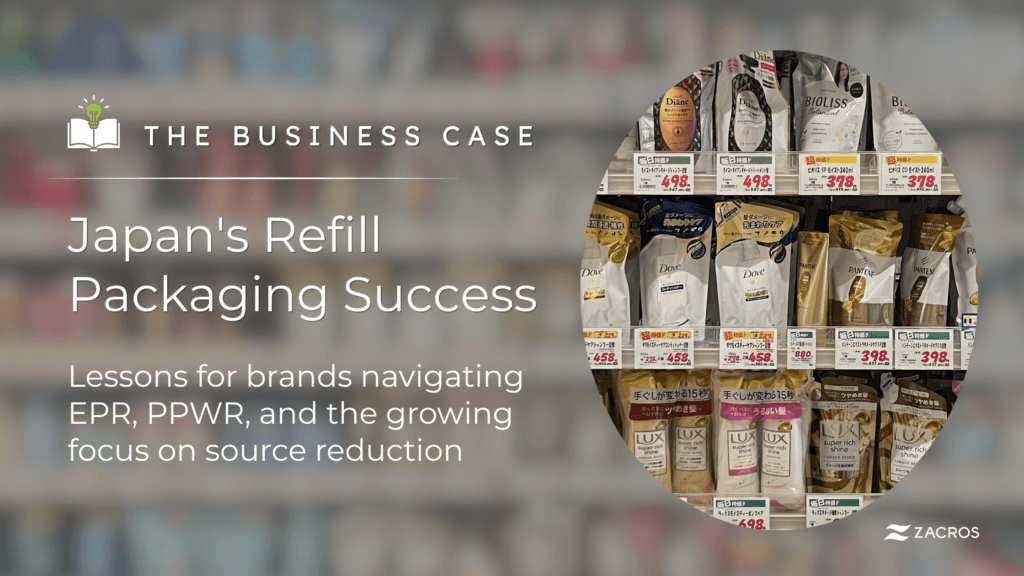
Japan’s experience offers valuable insights into how packaging reduction can move from a sustainability initiative to a business strategy.
Why Japan Became the World’s Refill Packaging Success Story
Japan’s refill market did not emerge because consumers demanded sustainable packaging. It evolved from a combination of regulatory pressure, economic realities, and practical consumer benefits.
In the mid-1990s, Japan faced growing concerns about waste generation and shrinking landfill capacity. At the time, containers and packaging accounted for approximately 60% of household waste volume, creating increasing pressure on municipalities and waste management infrastructure.
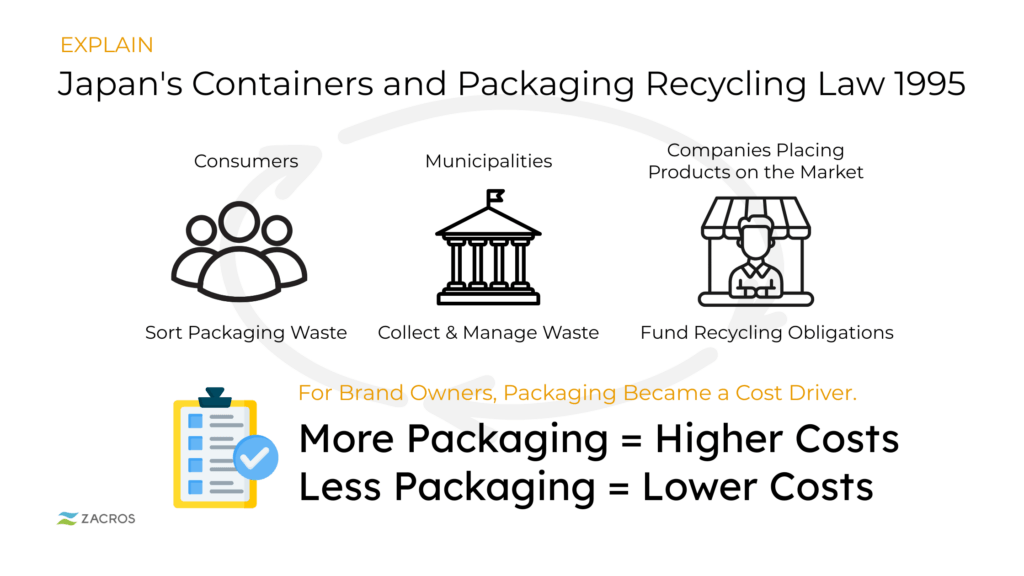
To address this challenge, Japan enacted the Containers and Packaging Recycling Law in 1995. The law established one of the world’s earliest large-scale EPR systems, requiring businesses that manufacture or use packaging to help fund the recycling of packaging waste. Consumers were responsible for sorting waste, municipalities collected it, and businesses paid recycling obligations through the Japan Containers and Packaging Recycling Association (JCPRA).
What made the system particularly important for brand owners was its economic structure.
In simplified terms:
Recycling Obligation = Packaging Quantity × Recycling Unit Cost
The actual calculation varies by material category and annual fee schedules, but the principle was straightforward:
More packaging = Higher responsibility costs
Less packaging = Lower responsibility costs
Packaging was no longer simply a container. It became a cost driver.
For home and personal care brands, refill pouches quickly emerged as an attractive solution. By replacing relatively heavy bottles with lightweight refill packages, companies could significantly reduce the amount of packaging entering the market while still selling the same amount of product.
At the same time, Japan was experiencing prolonged economic stagnation following the asset bubble collapse. Consumers became increasingly value-conscious and focused on maximizing household spending.
Refill pouches aligned perfectly with both realities. Brands could reduce packaging material and packaging-related obligations, while consumers could purchase the same product at a lower cost per unit.
Sustainability created the opportunity, but value drove adoption. Consumers adopted refill pouches because they provided a practical and economical alternative to repeatedly purchasing a new bottle.
What Brands Can Learn from Japan
Lesson 1: Sustainability Succeeds When It Creates Business Value
One of the most important lessons from Japan is that refill packaging was never positioned solely as an environmental initiative.
It solved multiple problems at the same time.
- Policymakers wanted less packaging waste.
- Brands wanted to reduce packaging costs.
- Consumers wanted greater value.
- Waste systems needed less material to manage.
When sustainability initiatives create value for all stakeholders, adoption becomes significantly easier.
This remains highly relevant today as EPR programs expand across North America and Europe.
Lesson 2: Consumers Chose Refill Because It Made Economic Sense
Many companies assume consumers must be highly environmentally motivated before refill systems can succeed. Japan’s experience suggests otherwise.
Refill pouches became mainstream not because consumers were actively looking for sustainable packaging, but because they offered a practical advantage. Consumers could continue using products they already trusted while purchasing refill packs that often cost less and generated less waste than buying a new bottle each time.
Rather than asking consumers to choose between sustainability, convenience, and affordability, refill pouches delivered all three.
Real-world examples illustrate this benefit. For some Kao Bioré u products, refill formats provide meaningful cost-per-volume savings compared with purchasing a new bottle. In certain cases, refill packs cost approximately 15% less per milliliter than the primary package.
The broader lesson is that refill adoption was driven by value, not sacrifice. Consumers were not being asked to spend more or give up product performance. They were simply offered a more economical way to purchase products they were already buying.
This remains highly relevant today. As inflation and cost-of-living pressures continue to influence purchasing decisions, consumers are increasingly evaluating products through both a financial and environmental lens. Packaging solutions that reduce waste while helping consumers save money are often positioned for broader adoption than solutions that rely on sustainability benefits alone.
The lesson is simple: consumers rarely purchase sustainability on its own. They purchase solutions that provide value, and sustainability becomes an additional benefit.
Lesson 3: Industry-Wide Participation Accelerates Adoption
Another reason refill succeeded in Japan is that it was never limited to one company or one product category.
Consumers regularly encountered refill formats across:
- Hair care
- Body care
- Laundry care
- Dishwashing liquid
- Hand soap
- Household cleaning liquids
- Cosmetics and beauty products
- Pet care
Refill was no longer associated with a single brand. It became a familiar purchasing behavior.
Industry groups also played an important role. Organizations such as the Japan Soap and Detergent Association (JSDA) established plastic-reduction goals, shared best practices, and published real-world case studies that highlighted successful packaging reduction initiatives. As more companies reported measurable results, refill packaging became less of an experiment and more of an industry standard.
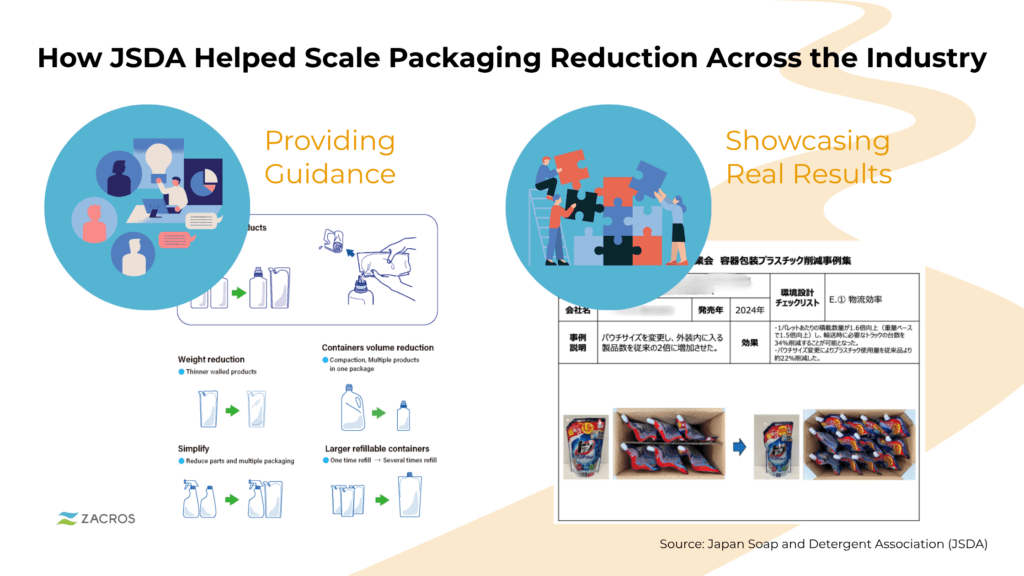
As more brands introduced refill options and publicly demonstrated measurable results, refill gradually moved from being an innovative packaging concept to becoming the expected way to purchase many household products.
Consumers did not need to learn a different system for every brand. They encountered similar refill formats repeatedly across store shelves, making refill purchasing increasingly familiar and convenient.
Over time, consumer acceptance followed industry adoption. The behavior became normalized.
Lesson 4: Refill Changed the Role of the Rigid Bottle
The impact of plastic reduction can be seen in data from the JSDA, which reports that plastic use per shipment volume in Japan’s soap and detergent industry was approximately 43% lower in 2024 than in 1995. Refill pouches, concentrated products, container reuse, and packaging redesign all contributed to this reduction.
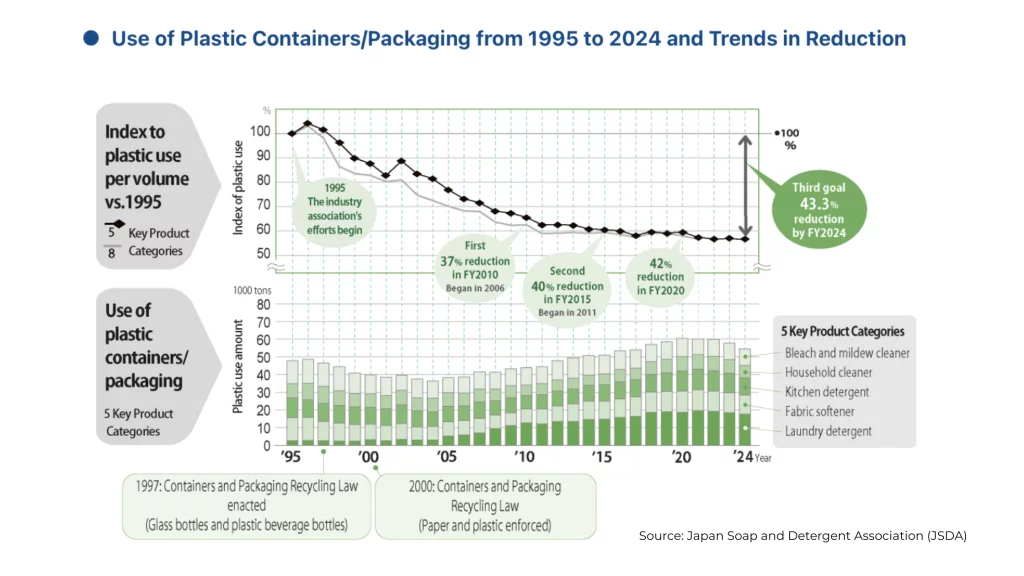
The significance of this achievement is that it was accomplished without fundamentally changing the products consumers purchase. Instead, it demonstrates how incremental packaging improvements, when adopted across an entire industry and sustained over decades, can create meaningful environmental impact. Refill pouches became one of the clearest examples of how a relatively small packaging change can significantly reduce material consumption at scale.
Refill pouches did not eliminate rigid packaging. They changed its role. Instead of being discarded and replaced with every purchase, the bottle became a durable container designed to remain in the home. Consumers purchased the bottle once and replenished it multiple times, turning what had traditionally been disposable packaging into a long-term part of the product experience.
This created new expectations for rigid packaging.
Bottles needed to be:
- More attractive
- Compatible with refill pouch fitments
- Designed for repeated use
- Equipped with higher-performing pumps and dispensing systems
In many ways, refill transformed the rigid bottle from a disposable package into a durable component of a larger packaging system.
The rigid packaging did not disappear.
It evolved.
Japan’s experience suggests that source reduction does not eliminate packaging innovation. Instead, it shifts innovation toward creating containers that deliver greater functionality, better consumer experiences, and longer service lives while using fewer resources overall.
Lesson 5: Regulations Can Accelerate Innovation
It would be inaccurate to say regulations alone created Japan’s refill market.
However, regulations helped create the conditions that accelerated innovation.
Once packaging became directly connected to recycling obligations, companies had a financial incentive to use less packaging.
This shifted packaging discussions away from simple unit costs and toward broader considerations:
- Material efficiency
- Transportation efficiency
- Waste reduction
- Package functionality
- Lifecycle impact
Many of today’s emerging regulations are creating similar incentives.
Japan provides a useful preview of how companies may respond when packaging reduction becomes economically rewarded rather than simply environmentally encouraged.
Looking Ahead
Japan’s refill pouch success story is often viewed through the lens of sustainability. While environmental benefits played an important role, the more interesting story is how economic incentives aligned across the value chain.
Regulators wanted less packaging waste. Brands wanted to use less material and lower packaging-related costs. Consumers wanted better value. Refill pouches delivered all three. Because refill created value across the entire system, adoption followed naturally.
As packaging regulations continue to evolve, Japan offers an important reminder:
The most successful packaging innovations are not adopted because they are environmentally beneficial. They succeed because they create value for businesses, consumers, and society at the same time.
Not sure where your current packaging stands?
Evaluating performance across your full system, from storage to dispensing, can uncover opportunities for improvement without rethinking your product. Contact us to start a conversation about your next packaging project and discover solutions tailored to your application.