
When packaging decisions are evaluated, discussions often focus on material costs, product protection, branding, and sustainability. Yet one of the largest packaging inefficiencies is not the package itself. It is the empty space that moves through the supply chain before a product is ever filled.
For decades, bottles, jugs, and pails have been the standard for liquid products. Many companies spend time negotiating pennies out of packaging costs while overlooking the fact that its packaging format requires significantly more truck and warehouse space than necessary. Because rigid packaging occupies the same amount of space whether full or empty, companies may be paying to transport large amounts of unused space.
As transportation costs rise and organizations work to reduce Scope 3 emissions, companies are looking beyond packaging materials and evaluating how efficiently packaging moves through the supply chain.
Empty Packaging Creates Hidden Supply Chain Costs
Rigid packaging occupies the same amount of space whether they are full or empty. As a result, trucks, warehouses, and production facilities often dedicate significant space to storing and moving packaging that contain no product at all.
This impacts:
- Warehouse utilization
- Transportation efficiency
- Inventory storage costs
- Carbon emissions associated with logistics
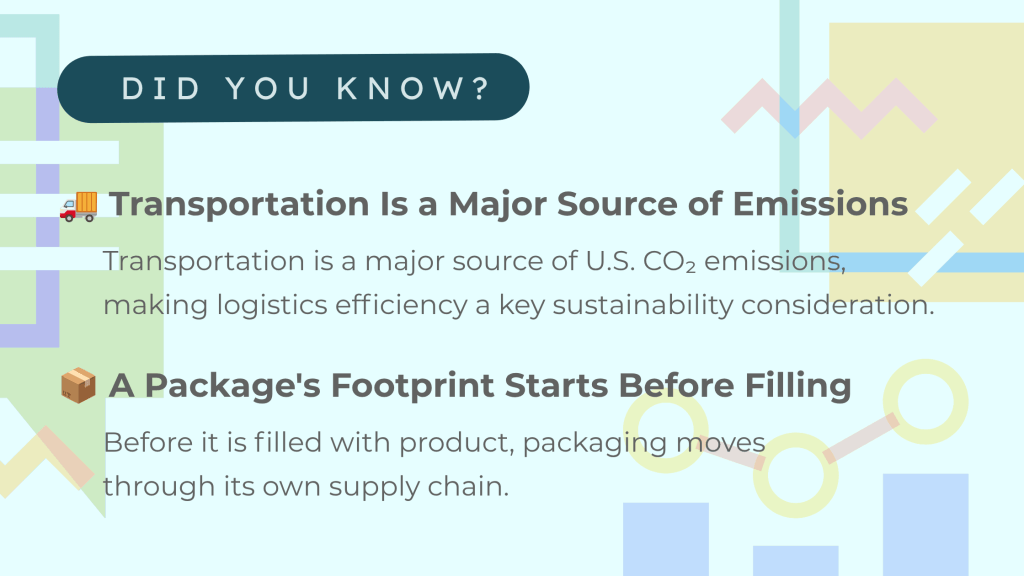
According to the U.S. Environmental Protection Agency (EPA), transportation remains one of the largest contributors to greenhouse gas emissions in the United States. That is why improving logistics efficiency can play an important role in reducing environmental impact.
Why Cube Utilization Matters
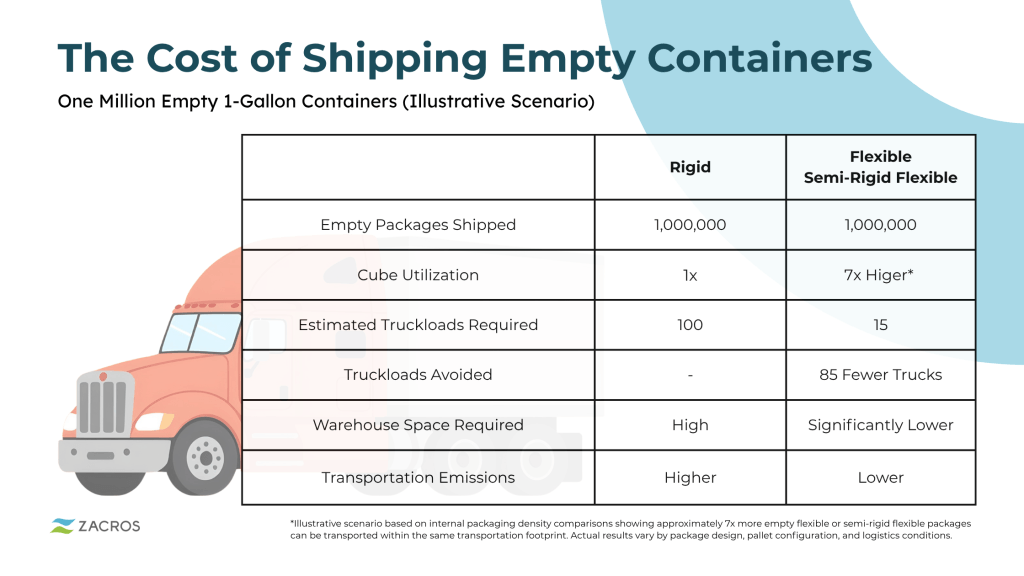
Cube utilization measures how effectively a warehouse, shipping container, or vehicle uses its available storage capacity. This metric plays an important role in analyzing logistics efficiency. When transporting empty rigid packaging, available space is often exhausted long before weight limits are reached. As a result, companies may be paying to move large amounts of unused space throughout their supply chain.
Packaging formats that reduce empty volume can significantly improve cube utilization, allowing more packages to be transported, stored, and handled within the same logistics network.
Flexible packaging was developed, in part, to address this inefficiency. Because flexible packaging can be supplied in roll stock, flat pouches, or collapsible formats, significantly more packaging can be transported and stored within the same footprint compared to rigid alternatives.
The result is improved logistics efficiency throughout the supply chain.
Example: The Cost of Shipping Empty Containers
The Sustainability Impact of Shipping Less Air
Sustainability discussions often focus on materials and recyclability and transportation efficiency receives far less attention despite its direct impact on emissions, fuel consumption, and cost. The Sustainable Packaging Coalition (SPC) notes that transportation and distribution are important considerations when evaluating packaging’s overall environmental footprint.
While reducing empty space throughout the supply chain can deliver meaningful environmental benefits, companies are often challenged to maintain the durability and functionality expected from rigid packaging. This has created interest in packaging formats that bridge the gap between traditional rigid containers and conventional flexible pouches.
Beyond Flexible: The New Category of Liquid Packaging
While flexible packaging offers significant space-saving advantages, some applications still require additional structure and durability.
This has led to growing interest in a new category: semi-rigid flexible packaging. It combines many of the logistical advantages of flexible packaging with enhanced functionality for handling, dispensing, stacking, or product protection.
Rather than forcing to choose between rigid and flexible formats, semi-rigid flexible packaging offers an alternative that balances both characteristics.
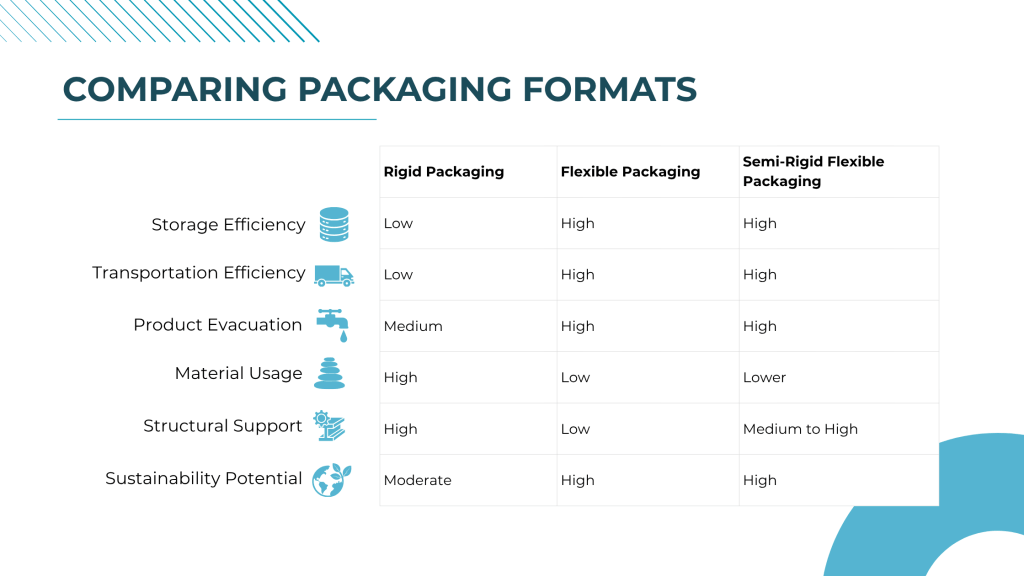
The optimal solution depends on the application, but the industry is increasingly recognizing that packaging formats exist on a spectrum rather than in two distinct categories.

Looking Beyond Packaging Category
The future of packaging innovation is not simply about replacing one material with another.
Instead, companies are evaluating packaging through a broader lens that includes supply chain efficiency, product performance, user experience, and environmental impact. As businesses continue searching for ways to improve operational efficiency and sustainability, flexible and semi-rigid flexible packaging formats are likely to play an increasingly important role.
Conclusion
The cost of packaging is not limited to the package itself. Every pallet, truckload, and warehouse occupied by empty containers represents a hidden cost within the supply chain.
By reducing the amount of empty space that must be transported and stored, flexible and semi-rigid flexible packaging can offer benefits that extend well beyond material reduction alone. Many companies are discovering that packaging decisions affect far more than the package itself. They also influence truck capacity, warehouse utilization, and transportation costs throughout the supply chain. The next opportunity for efficiency may not come from shipping more product, but from shipping less air.
Not sure where your current packaging stands?
Evaluating performance across your full system, from storage to dispensing, can uncover opportunities for improvement without rethinking your product. Contact us to start a conversation about your next packaging project and discover solutions tailored to your application.