
When evaluating packaging for liquid products, companies often compare two primary options: rigid packaging such as drums, jugs, and bottles, or flexible packaging such as pouches and film-related packaging.
But what if the best solution is neither?
For some liquid applications, neither rigid nor fully flexible packaging offers the right balance of performance and efficiency. This is where semi-rigid flexible packaging can provide an alternative. As companies look for ways to improve packaging efficiency, reduce material use, and meet evolving sustainability goals, interest in semi-rigid formats continues to grow.
The Limitations of Traditional Packaging Choices
Rigid packaging: strong, but inefficient
Rigid containers have long been the default for liquid products due to their durability and familiarity. However, they come with trade-offs, such as:
- Fixed shape leads to unused headspace
- Requires more transportation and storage space
- Higher plastic usage
- Air exposure during dispensing may affect product stability
These limitations become increasingly important as supply chains face pressure to reduce cost, emissions, and overall plastic usage.
Flexible packaging: efficient, but not always practical
Flexible pouches and film-related formats solve many of these issues:
- Lightweight
- Space-efficient
- Lower material usage
However, they can present limitations depending on the application.
- Limited structural support in certain environments
- Compatibility challenges with harsh chemicals
- Less suitable for larger volume applications
Flexible packaging can provide significant advantages across logistics cost to material efficiency, making it an attractive option for many applications. However, performance can vary depending on the product and operating environment.
Enter the “Missing Middle”: Semi‑Rigid Flexible Packaging
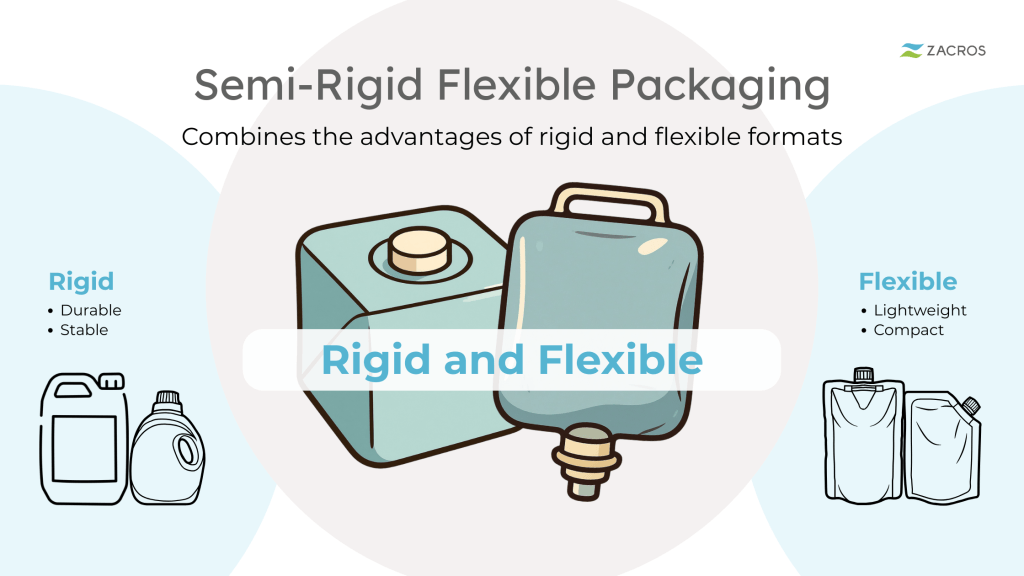
Semi‑rigid flexible packaging was developed to bridge the long-standing gap between rigid and flexible formats. At ZACROS, our experience working with liquid packaging applications has shown that many customers need a solution that offers both operational durability and efficiency.
Semi‑rigid flexible packaging retains enough structure for reliable handling and system compatibility, while at the same time offering the flexibility needed to improve efficiency across logistics and use.
This combination makes semi-rigid packaging well suited for liquid products in industries ranging from chemicals and cleaning products to personal care applications.
What Makes Semi‑Rigid flexible Packaging Different?
Unlike rigid containers that maintain a fixed shape, or flexible packaging that fully collapses, semi‑rigid flexible packaging formats maintain partial shape for handling and stability, while still allowing controlled collapse during dispensing.
As a result, this design combines characteristics of both rigid and flexible packaging, allowing companies to balance product protection, efficiency, and ease of use.
- Improved product utilization
In rigid containers, residual product is often left behind. Semi‑rigid flexible packaging helps reduce this issue by allowing the package to contract as liquid is dispensed, improving overall product yield.
- Better product protection during use
Because the package contracts as product is dispensed, less air is introduced into the system. This can help reduce oxidation, maintain formulation stability, and improve product preservation.
- Optimized logistics and storage
Semi‑rigid packaging can often be stored or shipped more efficiently similar to flexible formats. Some designs can be shipped and stored in a compact form prior to filling, helping reduce warehouse requirements and transportation costs.
A Shift from Format to System Thinking
In the past, packaging decisions often came down to choosing between rigid and flexible formats. Today, however, more companies are taking a broader view by assessing how a packaging system performs across the entire product lifecycle, from transportation and storage to dispensing and end use. Semi‑rigid flexible packaging plays a critical role in this shift because it enables optimization across multiple stages.
For example, companies packaging large-volume cleaning chemicals often need the storage and transportation efficiencies of flexible packaging while still requiring enough structure to support dispensing systems. In these cases, semi-rigid packaging can help balance both requirements.
When Does Semi‑Rigid Packaging Make Sense?
This “missing middle” approach is especially relevant when:
- Product is sensitive to air exposure
- Operations require efficient storage and transport
- Flexible packaging is desired, but added durability is required
Wide range of industries such as commercial cleaning dispenser, cosmetics refill, and industrial liquids are increasingly exploring this hybrid packaging solution.
Finding the Right Packaging Balance
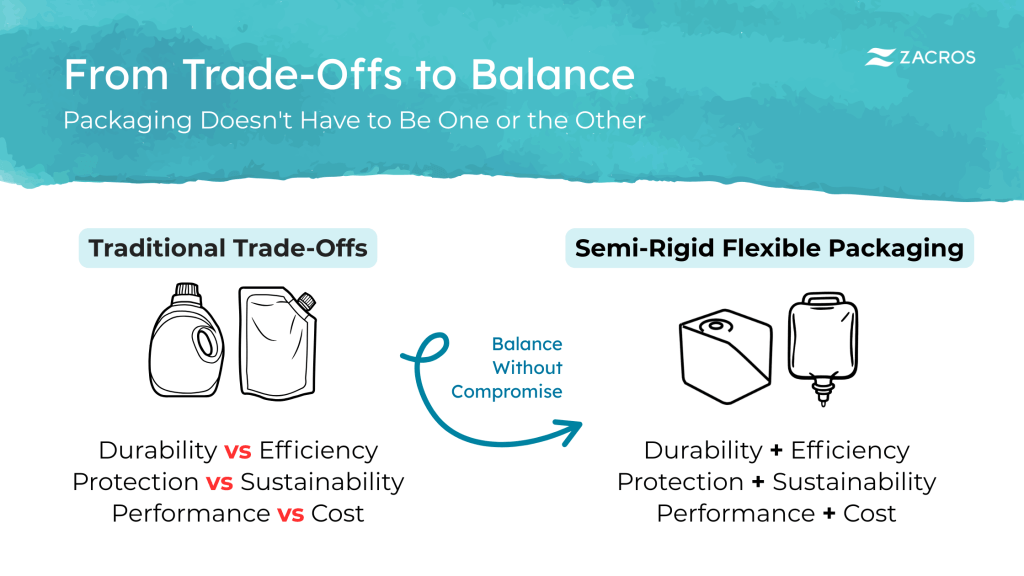
For years, packaging decisions have been framed as trade-offs such as:
- durability vs efficiency
- protection vs sustainability
- cost vs performance
Semi‑rigid flexible packaging challenges that mindset. Rather than prioritizing one benefit at the expense of another, semi-rigid packaging can help companies improve efficiency while maintaining product protection and functionality.
Final Thought
As supply chains evolve, packaging decisions increasingly depend on overall system performance rather than format alone.
The question is:
Does your packaging system work as efficiently as it should?
For many applications, semi-rigid packaging provides a practical alternative that combines advantages from both rigid and flexible formats.
Not sure where your current packaging stands?
Evaluating performance across your full system, from storage to dispensing, can uncover opportunities for improvement without rethinking your product. Contact us to start a conversation about your next packaging project and discover solutions tailored to your application.