
Why recyclability alone does not protect your product, cost structure, or brand
Packaging decisions for liquid products are often framed as straightforward choices: plastic or glass, bottle or pouch, recyclable or not.
In practice, these decisions are rarely simple.
For companies managing liquids whether cosmetics, personal care, home care, chemicals, or industrial products, the wrong packaging choice can create costly problems such as leaks in transit, wasted product, regulatory issues, logistics inefficiencies, or sustainability trade‑offs that do not deliver real impact.
To address these challenges, ZACROS AMERICA developed the guide Choosing the Right Liquid Packaging to support beyond surface‑level decisions and evaluate packaging from different perspectives.
This blog outlines the underlying considerations behind effective liquid packaging decisions. The guide provides the framework to apply them with confidence.
Recyclable ≠ Sustainable (and the data proves it)
Discussions around packaging sustainability often focus narrowly on recyclability. While recyclability remains an important consideration, it represents only one component of a package’s overall environmental impact.
Material usage, transportation efficiency, damage rates, and product waste often contribute more significantly to total environmental footprint than end‑of‑life outcomes. Even the U.S. EPA ranks source reduction above recycling in its waste management hierarchy. That difference is rarely visible at the design stage.
The guide dives into:
- Why lighter, space‑efficient packaging can outperform “recyclable” options
- How logistics and transport emissions affect your total footprint
- Why real sustainability decisions require a Life Cycle Assessment (LCA)
Compatibility Failures in Liquid Packaging Are Often Not Immediately Detectable
Chemical compatibility remains one of the most underestimated risks in liquid packaging.
Liquids interact with packaging materials over time. Some cause swelling. Others weaken seals, degrade layers, or impact product efficacy. For example, citrus‑based or fragrance‑heavy formulations can gradually diffuse into polyethylene packaging, leading to softening or dimensional change that may not be visible during initial trials. Such effects are rarely apparent during short‑term trials, yet they may emerge months later during storage, distribution, or consumer use.

We highly recommend compatibility testing such as ASTM D543 before finalizing your packaging.
Inside the guide, we explore:
- Formulation‑specific interactions
- How barrier needs differ based on light, oxygen, and moisture sensitivity
- Long‑term stability and product efficacy
Closure‑Related Failures Are a Common Source of Leakage in Liquid Packaging
Closure systems are exposed to concentrated mechanical stress and process variability throughout the packaging lifecycle. Factors including torque control, seal cleanliness, alignment, internal pressure, and dispensing behavior all influence closure performance.
As a result, closure‑related failures are commonly observed in liquid packaging, particularly when package design, product characteristics, and filling conditions are not fully aligned. Once leakage occurs, the consequences often extend beyond the individual package. Escaped product can damage or contaminate surrounding goods during storage and transport, increasing the scope and cost of the failure.
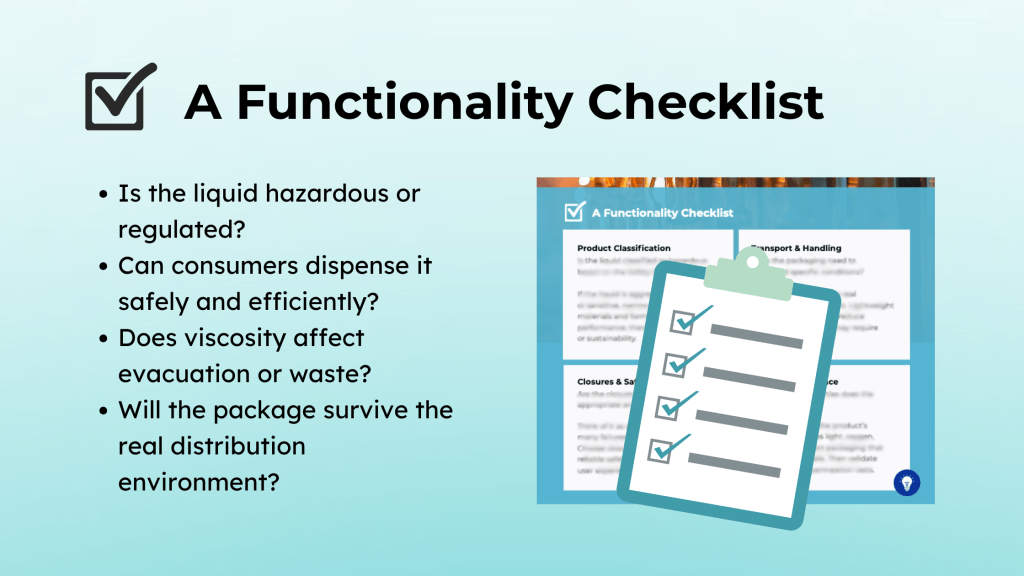
To address these risks, the guide introduces a Functionality Checklist that helps teams evaluate packaging as a complete system, including questions such as:
- Is the liquid hazardous or regulated?
- Can consumers dispense it safely and efficiently?
- Does viscosity affect evacuation or waste?
- Will the package survive the real distribution environment?
Total Packaging Cost Extends Beyond Unit Price
The economic impact of packaging is not captured by material price alone.
In our experience working with liquid packaging systems, downstream factors such as freight efficiency, damage rates, and line performance have greater influence on total cost than unit price decisions made in isolation. For many consumer goods companies, transportation and storage alone represent approximately 6–8% of revenue.
In the guide, we unpack:
- How lightweight and collapsible formats reduce logistics costs
- Why “cheap” packaging can increase total cost of ownership
- Where production inefficiencies silently erase savings
Packaging decisions made in isolation from operations and supply‑chain constraints rarely protect margins in the long term.
Objective Comparison of Packaging Formats Requires Evaluation of Trade‑Offs Rather Than Assumptions
Rigid bottles, flexible pouches, glass, aluminum, Bag‑in‑Box, and CUBITAINER® formats each offer distinct advantages and limitations.
Meaningful comparison requires evaluation across multiple dimensions, including:
- Functionality
- Durability
- Barrier performance
- Cost
- Carbon footprint
- Resource usage
- Real‑world recyclability
Side by side comparisons (applications under 1 gallon and between 1 and 5 gallon) highlight why no single format is universally optimal. The most appropriate packaging solution depends on the relative priorities of the business.
A Practical Framework for Packaging Decisions Involving Liquid Products
Liquid packaging decisions are complex and oversimplifying introduces avoidable risk.
Whether re-evaluating existing packaging or developing a new liquid product, the guide provides a practical reference for evaluating liquid packaging decisions earlier in the development and sourcing process.
👉 Download Choosing the Right Liquid Packaging: Finding the Best Fit for Your Liquid Product