
When brands talk about refill pouches, the discussion almost always centers on sustainability. Less plastic. Lower carbon footprint. Reduced waste.
Sustainability matters but it is not the whole story. In reality, refill pouches change buying behavior in ways that go well beyond environmental impact. We call this the Refill Pouch Benefit Cycle and it is increasingly one of the most overlooked source of business growth in packaging strategy.
The sift is already visible in the market. In an interview with Beauty Packaging, Kiehl’s Since 1851, one of the most established refill pouch adopters in beauty industry, confirmed that refill pouch sales are growing rapidly across global markets. According to Maggie Kervick, Global Head of Sustainability and CSR at Kiehl’s, refill pouches are no longer a niche sustainability initiative. They now play a meaningful role in business growth.
What Is the Refill Pouch Benefit Cycle?
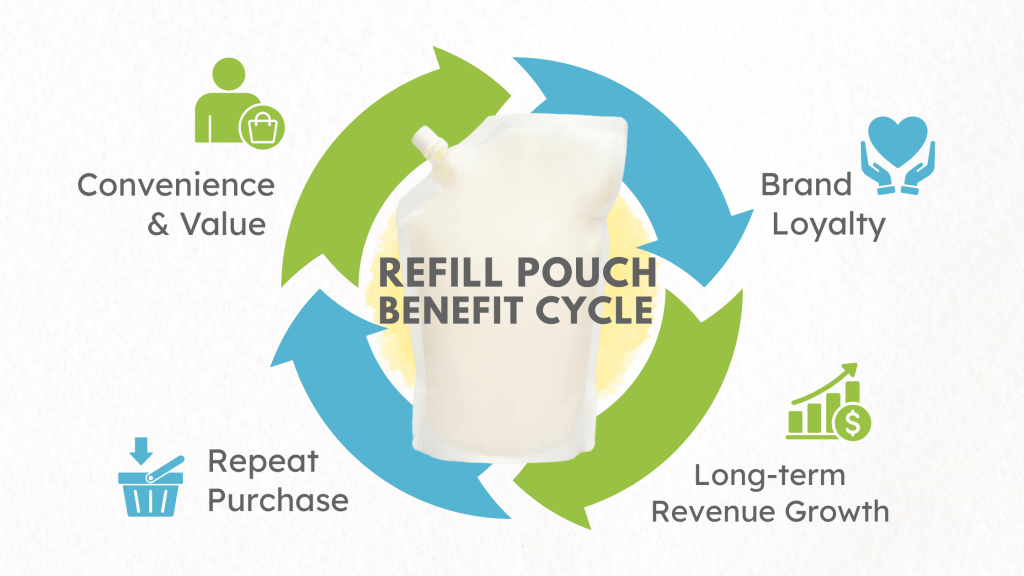
The Refill Pouch Benefit Cycle describes how refill formats create a loop of value that benefits both brands and consumers.
Refill pouch → Convenience & value → Repeat purchase → Brand loyalty → Long‑term revenue growth
This cycle is especially powerful in categories with frequent replenishment, such as personal care, home care, and cosmetics.
Below, we break down what actually happens at each stage and why it matters commercially.
1. Refill Pouches Reduce Friction at Repurchase (Because Consumers Want Fewer Decisions)
Today’s shoppers are not just looking for “better” products, they are looking for easier decisions. Research indicates that buying has become cognitively exhausting. Accenture reports that 74% of consumers walked away from purchases in late 2023 not because options are bad, but because there are too many of them.
This shows up clearly in McKinsey’s description of the consumer “loyalty loop,” where satisfied customers bypass active evaluation and return directly to a brand they already trust. Refill pouches naturally support this behavior. Once a consumer owns the primary packaging, the refill becomes the straightforward way to repurchase, no comparison required.
Why this matters:
Refill pouches are a decision-simplification tool. In a world where consumers are overwhelmed by choice, simplifying repurchase is one of the most reliable ways to drive repeat purchase and retention.
2. Cost Savings Encourage Habitual Buying
Refill pouches are typically priced lower than full primary packaging, giving consumers a more affordable way to repurchase products they already trust. This price difference matters more today than it did a few years ago. As households become more value‑conscious about everyday spending, even small savings can shape repeat behavior.
When refills offer a clear cost advantage for product consumers already trust, they become the default repurchase choice, particularly in categories with frequent replenishment.
Why this matters:
Lower price, a familiar product, and reduced waste combine to reinforce repeat behavior. In practice, refill pouches can become a habit‑forming, value‑led growth driver, not just a sustainability feature.
3. Refill Models Strengthen Brand Loyalty
Refill systems do more than reduce packaging. They change the nature of the brand relationship.
Brands that introduce refill options signal long‑term commitment to sustainability, which resonates strongly with younger consumers. Surveys consistently show that Gen Z shoppers, in particular, actively seek out brands that demonstrate environmental responsibility.
At the same time, refill and reuse systems create repeated interaction with the same branded container. Studies from McKinsey and the Ellen MacArthur Foundation indicate that refill system can increase customer retention by encouraging repeated interaction with the same branded container, making repurchase easier, reducing brand switching.
Why this matters:
Refill models strengthen loyalty by making repeat purchase feel automatic. For value‑driven consumers, sustainability becomes part of a routine rather than a decision point, supporting loyalty through behavior, not messaging alone.
4. Loyalty and Repeat Purchase Support Long‑Term Revenue
The final stage of the Refill Pouch Benefit Cycle is greater revenue stability.
UNEP estimates that converting just 20% of single‑use packaging to reusable or refill systems globally could estimate a USD 10 billion economic opportunity, driven by material efficiency and repeat consumption models.
Unlike promotional discounts or short‑term sustainability claims, refill systems operate quietly in the background, reinforcing continuity over time.
Why this matters:
Refill pouches do not just reduce environmental impact. They create a resilient, long‑term business opportunity.

The Refill Pouch Benefit Cycle Summary
Refill pouches:
- Reduce friction at repurchase
- Encourage habitual buying through cost and convenience
- Strengthen brand loyalty through repeated use
- Support long‑term revenue growth
Each benefit reinforces the next, creating a cycle that grows stronger with every refill.
Why Brands Are Rethinking Refill Pouches Now
As regulatory pressure on single‑use packaging increases and consumer expectations around sustainability rise, refill pouches are moving from optional innovation to strategic necessity. In many cases, brands are responding simply because customers are asking for refill options.
Most brands are already talking about refill. The difference will be which ones understand why it actually works.
Are You Ready to Explore Sustainable Packaging for your Products?
ZACROS has provided quality flexible packaging for beauty liquid products for over 25 years. We have an intensive chemical compatibility database to find you with a suitable packaging solution. Contact us today to learn more.